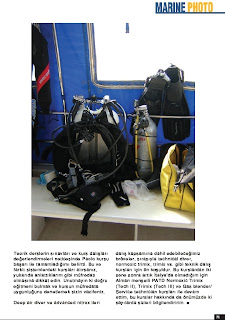
Sn. Ateş Evirgen, Sualtı Dünyası (Marine Photo) dergisinin 126'ncı sayısında, benim üçüncü makaleme de yer verdi.
I created this blog as a place to store dive related information, such as technical diving, decompression theory, equipment configuration, etc...
11 Temmuz 2012 Çarşamba
Sualtı Dünyası Dergisinin 126'ncı sayısı yayında
Sn. Ateş Evirgen, Sualtı Dünyası (Marine Photo) dergisinin 126'ncı sayısında, benim üçüncü makaleme de yer verdi.
13 Haziran 2012 Çarşamba
What exactly is "Oxygen Cleaning" by Harry Avril
You probably know the story of the blind men and the elephant. If you somehow missed it, here's the short version:
Three blind men came upon an elephant. The first, feeling the animal’s leg, proclaimed that an elephant must be much like a tree trunk. The second, finding the animals trunk, said that a more apt comparison would be a snake. The third, holding on to the elephants tail, was puzzled by the first two’s misinterpretation of the facts. To him, an elephant felt exactly like a rope.
We see much the same confusion taking place over our new Modular Valve System (MVS) tank valves. These components come from the factory free of hydrocarbons and other flammable contaminants. The lubricants used in the valve assembly are non-combustible. The o-rings and seals are made from Viton or other oxygen-compatible materials.
Aha!" say the blind men, “These new MVS components must be much like the oxygen clean or oxygen service rated equipment we read about in textbooks."
Not exactly. This may, in fact, be a good time to open your eyes to the facts regarding oxygen cleanliness.
Oxygen Cleaning in the Big Leagues
When the aerospace industry needs a component “oxygen clean,” they do not simply take it out in back, hose it down with Simple Green and swap out a few o-rings. True oxygen cleaning takes place in a special “clean room,” whose atmosphere is free of dust and contaminants.
Once the component is free of hydrocarbons and other combustible elements, it is sealed within a sterile environment and never again exposed to normal atmospheric dust, moisture and contaminants. This is what it means to be oxygen clean.
So Are the Textbooks Wrong?
I say the word boat. You envision a rowboat. I'm thinking of the Queen Mary. Which of us is wrong?
The problem here is a matter of semantics. (A term used to describe the process of using word meanings to prove that you're right and the other guy doesn't know what he's talking about.)
If you are writing a textbook, you can get away with using a broad definition for oxygen clean and oxygen service. That's because textbook writers have yet to come under the scrutiny of America's insurance underwriters and trial lawyers. When you are a manufacturer or distributor, you are continually in the specter of "product liability." This holds you to a higher standard of countability and motivates you to choose your words carefully.
So What Can we Say about MVS Components?
The broadest label we can apply to MVS components is to say that they are Nitrox ready. But wait--isn't all dive equipment suitable for Nitrox use when filled from a pre-mixed source? If the pre-mixed source is no richer than EAN 40 (40 percent oxygen), the answer is yes.
Okay. How about using MVS components in an "oxygen clean" cylinder in which you plan to do partial-pressure Nitrox mixing? Let's put on our tap-dancing shoes here.
When new, the latest generation of MVS components comes from the factory free of hydrocarbons and other combustibles. They use Viton and other oxygen-compatible O-rings and seals. They are not, however, assembled in a clean room or sealed in a sterile environment. Additionally, we have no control over what happens to the valves after they leave us.
As a result, labeling our new MVS components as oxygen clean or oxygen service rated (although they may appear to meet the most commonly used criteria among the technical diving community), is not accurate. The best analogy might be the futility of trying to determine whether a new diver is "safe." The fact is, once you give that diver his or her Ccard, you have limited control over the diver's behavior or the choices he or she makes. Therefore, there is no way you can label such a diver "safe" or "unsafe."
The real problem, of course, has to do with the present legal climate in the United States. Makers of dive equipment are every bit as hamstrung as other manufacturers. So bad have things gotten that you can no longer claim that a BC might provide surface flotation, or that a dive computer might be used to avoid decompression illness.
Tort reform legislation recently passed by Congress may help; however, the real solution lies with individuals. If you want to participate in technical diving, you have a duty to educate yourself to the degree needed to make sound decisions-and, having made a decision, you must be willing to take responsibility for it. If you are not, you only stand to make diving so expensive that none of us can afford to participate.
3 Mayıs 2012 Perşembe
Manifolds
“Ideal” Manifolds…
Not So Ideal?
By Jeffrey Bozanic, NSS-CDS 181, NSS 22353
Fellow
October 2005
The Benjamin Conversion manifold, or as it is more popularly
called, the dual valve manifold, was utilized for cave diving and other
environments in which regulator redundancy was deemed beneficial throughout the
late 1970s to the mid-1990s. This manifold was a vast improvement over the
pre-existing manifolds of the day, as they allowed two independent regulator
systems to be used on the same set of doubles. Thus, if a regulator failure
occurred (either first or second stage), the diver still had a viable option for
self-rescue from the cave. During this time, cave divers worried about a few
possible failures that could still result in catastrophic gas loss from the
primary gas supply. These included:
- Burst disk failure
- Sudden, massive failure of one of the cylinder neck o-rings which seals the manifold
- Loss of integrity of the manifold itself
These concerns lead to the development of the “Ideal” or
isolation manifold, which allowed the two cylinders to be isolated from each
other, maintaining at least part of the gas in the event of one of the failures
listed above. It was considered a vast improvement, and very quickly replaced
the use of the “unsafe” dual valve manifold. It is the primary manifold used
today for all forms of technical open circuit diving. Yet, my opinion is this
valve does not add safety, rather it significantly reduces it.
During the twenty or so years in which the dual valve
manifold design was in use, there was only one recorded failure of the type
listed above that occurred while diving. This event occurred during a cave dive
while using a Sherwood manifold incorporating a metal-to-metal seal. Immediately
prior to the dive, the double cylinders were accidentally knocked off the
preparation platform. They fell about three feet to the ground, landing on the
manifold. The manifold was closely examined prior to diving, but was not
leaking, and the divers elected to dive. After the cylinder pressure had been
reduced to about 1500 psi, the manifold catastrophically failed, and both divers
exited successfully sharing gas from the remaining rig. It was suggested at the
time that the fall caused a displacement cylinders relative to each other, which
did not manifest itself until the pressure reduction allowed the metal-to-metal
seal to shift and lose integrity.
In addition, in 30 years of accident data collection, there
are two instances of in-water burst disk failure recorded. Both events occurred
with cylinders that had been pressurized beyond the working pressure of the
cylinders (in one case almost to the hydrostatic test pressure!), and occurred
within minutes of the cylinders being placed in the water (prior to cave
penetration, while in a safe environment). Also, in both instances, the burst
disks had not been replaced in many years. It can be hypothesized that the old
disks had metal fatigue from small flexing associated with repetitive filling
and emptying over the years, and failed due to thermal shock when placed into
relatively cold water after being sun warmed on the surface. Cave divers used to
alleviate this risk by double disking or soldering the disks shut, but these are
not recommended procedures. A far better practice is to replace all burst disks
annually. As both of these incidents occurred at the surface, prior to beginning
the dive, an isolation manifold would not have benefited the divers, since they
would have called the dive anyway.
In contrast, since the isolation manifold was introduced in
the early 1990’s, there have been many, many incidents related to misuse of the
manifold. Most of these have been rectified without harm to the divers involved,
but all of them had the potential for very serious consequences. The types of
problems associated with this design of manifold along with representative case
histories include:
- The isolation valve being closed prior to the dive.
Case #1: This involved a cave
diver who began the dive with 3,000 psi (200 bar) in his doubles. He and his
buddy did a S-drill prior to descending, indicating that both regulators were
working fine. About 15 minutes into the dive, he noted that the pressure on his
SPG was not dropping as expected. He reached up, opened the isolation manifold,
and watched as his pressure dropped from 2,700 psi (180 bar) to 1,700 psi (110
bar). He called the dive, and exited the cave with no further incidents.
What happened was that the diver
was in the practice of always leaving his isolation manifold open. However, when
he had it filled, apparently the fill station operator closed it. Thus, only one
cylinder was being utilized during the dive. The diver using the cylinders did
not check the isolation valve, since it was “always” open. The pressure drop
seen was due to the S-drill usage, BC and drysuit inflation, and cylinder
cooling after being placed into the water.
- The isolation valve being closed during filling of the cylinders.
Case #2: A cave diver planned a
nitrox dive to a depth of 110 ffw. Prior to the dive he analyzed his cylinders
and found that he had EAN32, as expected.
He proceeded to a depth of 50 ffw, whereupon he began to experience
symptoms of CNS oxygen toxicity. He immediately began sharing gas from his
buddy, and aborted the dive.
After examining the cylinders on
the surface, the team found EAN32 in one cylinder, and 100% oxygen in the
second. Apparently, at some time during the blending process, the isolation
valve was shut, resulting in only one cylinder being properly prepared. This was
the cylinder that was analyzed, and so everything appeared normal prior to the
dive. At no time prior to the dive did the diver check the isolation valve.
- Roll off of the left manifold valve.
Case #3: A cave diver swimming
through a tight cave passage experienced a sudden failure of his gas supply. He
switched regulators, and aborted the dive. After surfacing, he found that left
manifold valve was closed. It had been open prior to the dive, as evidenced by
his utilization of that regulator for the entire period up to the sudden supply
failure. His forward movement through the overhead environment resulted in the
“auto-shutdown” of the valve, as the hand wheel turned shut off as it scraped
across the ceiling.
These failures are only representative of those in the files,
and related to me anecdotally from other sources. Cases like this are very
numerous, and any of them could have resulted in a fatality. In my opinion, it
is only a matter of time until one does.
One might argue that these incidents did not need to occur,
and that it was the divers’ fault for not checking the isolation valve prior to
their dives. I do not disagree with this. However, when a piece of equipment
opens itself up to a multitude of cases of “pilot error,” while not providing
any concrete improvement in other areas of safety, then the net result is one of
additional risk with a commensurate reduction in safety. For this reason, and
the history of misuse of the manifolds in the field, my belief is that we should
go back to using the standard dual valve manifold of the 1980’s or adopt another
type of technology.
NOTE: This is one of a series of articles planned for Underwater Speleology, NACD News, and other journals of
interest to the technical diving community which will discuss findings from the
combined accident analysis files collected by the cave diving community.
About the Author:
Jeffrey Bozanic
P.O. Box 3448
Huntington Beach, CA 92605-3448
(714) 775-4462
E-mail: JBozanic@HQonline.net
Jeff was certified as a NAUI Instructor in 1978, and for the NSS-CDS in 1983.
He is certified to teach diving for the NSS-CDS, IANTD, TDI, and NAUI. Jeff is
active in teaching cave, rebreather, nitrox, technical nitrox, and trimix diving
courses. Together with his wife, Rebekah, he has maintained the combined
accident files for the cave diving community (a joint project of the NSS-CDS,
NACD, and IUCRR). He has published extensively on diving education topics, with
heavy emphasis on cave diving safety techniques. He has edited/reviewed many
diving textbooks, and is the author of Mastering Rebreathers. He has served on
several Boards of Directors in the diving community, including as Chairman of
the NSS-CDS and as Vice Chairman of NAUI, and as Treasurer on the AAUS Board.
Jeff has received the NAUI Outstanding and Continuing Service Awards; the Silver
Wakulla, Abe Davis, Henry Nicholson, and International Safe Cave Diving Awards;
the SSI Platinum Pro 5000 Award, and is a NAUI Hall of Honor inductee.P.O. Box 3448
Huntington Beach, CA 92605-3448
(714) 775-4462
E-mail: JBozanic@HQonline.net
Article Copyright
2005 Jeffrey Bozanic, All Rights Reserved
Separation Protocol by George Irvine
This is how we handle buddy separation issues. It is the responsibility of the front diver to know if the next guy is there or not. If he is not, the front stops, turns, and retraces. If the third guy stops, the second guy must stop and deal with him. It is still the responsibility of the front guy to know if the second guy is there. A light flash would be great, but the protocol must work in the event that a light flash is not possible.
It is the responsibility of the guys in back to hold light on the person in front of them such that the front person can see the beam and know the buddy is there. We stay close in all cave, regardless of size, but in small cave this prevents losing buddy at every turn, and it allows the buddy to ride through any silt or halocline or whatever stirred by the front guy without stopping and starting. If the vis gets really bad, the back guy's responsibility is to either be in touch contact with the front swimming or to bump the fins with the vehicle if scootering. This is standard WKPP stuff and I expect everyone to know this and adhere to it. I hate diving with people who can't play by these rules as it results in a slinky dive and a stress out. I personally thumb any dive where this or other breaches of protocol occur.
The front guy can do a sidewave signal if he can not see the back guy, which tells the back guy to swing his beam across the front guy's mask, showing that he is there. If the line is buried, the front guy must signal no line with his light (slow back and forth), and the back guy must automatically stop and hold his position on the line that he can still see. When the front guy finds the line ahead, he signals a fore and aft sweep of the light indicating he has regained the line, and the back guy can then proceed by returning the signal (not an "ok" signal).
We have no excuses for buddy separation lasting more than seconds. We stay as close as possible at all times. If you are not bumping into your buddy from time to time, you are too far away. The trick to what we do is team execution. The reason nobody can touch us in this game, including what are considered the 'best" in the world, is that they don't get this part. When Sheck Exley started diving with me, he was so amazed at what can be done our way that he talked to me every night at home and called me every day on his lunch break to talk about what dive we could do the next weekend. What Exley used to tough out by himself or with strokes over periods of weeks of aborted CFs, he could do with me in one day.
Just by way of comparison of philosophies, the UDSCT (made of up some of the most horrific idiots in Florida cave diving as well as the "best" from Europe and other places) took 90 days of diving to get halfway out JJ and my line in the main tunnel of Wakulla, and JJ and I went back after they were booted out and added to the end of our own line (twice as far as their max pen) in one dive in one day. The difference is in the ability to work a dive as a cohesive team. The little details are what makes this happen.
Oxygen Toxicity Protocol by Scott Hunsucker
The purpose of this protocol will be to establish standard operational procedures for dealing with in water oxygen toxicity events by divers of the Woodville Karst Plain Project. These techniques are not recommended for anyone's use except WKPP personnel. WKPP has removed the contact numbers on this web published document, the surface
manager will always have them at the appropriate site.
I. Possible Causes
A. Prolonged exposures to elevated PPO2's.
B. Sudden spike in PPO2 (i.e. switching gases).
C. Use of improper deco gas or use of gas at the wrong depth.
(This should NEVER HAPPEN)
II. Signs and Symptoms
A. Convulsions
B. Visual Disturbances
C. Ringing in the ears
D. Nausea
E. Muscle twitches, especially facial
F. Irritability
G. Dizziness
III. Assessment
Particular attention needs to be given to maintaining the divers airway, primarily after the seizure has ceased. It should be noted that the diver will NOT be breathing immediately following the seizure. This is a normal reaction and is to be expected. The diver should resume spontaneous respiration within 60 seconds. The diver should be carefully observed for the end of the tonic/clonic (seizure) period. During this period nothing should be done.
Care also needs to be given to the divers buoyancy. It is important that the diver remains close to the depth at which the seizure first occurred in order to prevent possible problems with decompression or air gas embolism (AGE)
IV. In Water Response for Tonic/Clonic episode w/o aspiration
A. Observe the seizure activity and stay close enough to the diver to prevent buoyancy problems.
B. After the seizure has stopped, maintain the diver in a face down (prone) and horizontal position. Check pulse.
C. If at all possible, transport the diver to the appropriate trough. The diver should ascend NO MORE than 10'. Descending to a deeper trough would be preferred. Transport needs to be carried out as soon as the seizure ceases and BEFORE respiration resumes.
D. Secure the diver in the trough. Place the diver on 20/20 mix or back gas (to lower PPO2). Place the regulator in the divers mouth and purge for a few seconds. Check pulse again. This also needs to be carried out before respirations resume.
E. Notify a support diver that there has been an oxygen toxicity episode, give them the divers name, depth, and time of oxygen toxicity event; at this point the support diver should immediately inform the surface manager.
F. Watch for the divers respirations to resume. Check the pulse again. If no spontaneous respirations occur within 60 seconds initiate artificial respiration. This should be done by use of the purge valve of the regulator. Purges should last for no more than 2 seconds, with an exhalation phase of 2-3 seconds. It will be necessary to manually open the divers airway and hold it in that position. This is done simply be lifting the chin upwards.
G. Once the diver has resumed respirations, note the time and wait for the diver to regain consciousness. The diver will be confused and may be combative for several minutes following, this is normal and to be expected. During this time talk to the diver to reassure him and maintain control. Once the diver is fully conscious, he should spend 15 minutes on a mix with a lower O2 percentage before resuming decompression. Deco should be resumed at the point that the diver became toxic.
H. After the toxicity episode the diver should be attended by a safety diver for the remainder of his/her decompression. This diver may well tox again and at NO TIME should they be left alone.
I. If the diver is wearing a full face mask w/ Q.D. regs, replace the gas line into the mask w/ a mix containing a lower oxygen content. Secure the diver in the trough and wait for him to regain consciousness. Notify support diver to inform surface manager. Keep the diver on the lower mix for 15 mins before allowing them to resume deco and watch carefully.
V. In water response for Tonic/Clonic episode with aspiration.
NOTE: Preventing aspiration is of utmost importance. Diligent attention needs to be given to the divers airway. If the regulator pops out of the divers mouth IT IS IMPERATIVE that the either the divers head is out of the water or that a regulator is replaced BEFORE respirations resume. The diver must stay in a prone (face down) position while being rescued.
A. Follow above steps for non-aspiration episode. If it appears that the diver aspirates proceed as follows.
B. Inform support diver that the diver in question has aspirated, they in turn will inform surface manager.
C. As long as the divers airway never relaxed underwater, then there should only be a small amount of water in the lungs. There is nothing that we can do about this underwater. The diver will most likely cough violently after he regains consciousness, therefore he will need to be watched very closely to prevent further damage.
VI. Surface responsibilities
A. Upon being notified of an oxygen toxicity event, write down all information given. It would be wisest to assign someone as a note taker. Careful documentation will be needed. A copy of divers name, depth and time of onset, deco status at time of onset and profile for dive, should be prepared in case diver has to be transported to the chamber.
B. The surface manage is to call or assign one person to call Tallahassee Community Hospital ER and advise them to let the chamber personnel know of the event. It might not be necessary to have the diver transported, but the forewarning of necessary personnel is advisable. If the diver has aspirated it is necessary to let them know, and that we will be coming to them as soon as it is safe to transport.
Recommendations:
1. Regulator retention straps for all decompression bottles.
2. Better mouth pieces on decompression regulators to facilitate retention in case of seizure.
3. Full face masks with quick disconnects for exploration team and divers with very long exposures.
4. Specially trained and designated safety divers, these divers should not be considered part of the support team. If this is not feasible than periodic training of all safety divers should be performed.
Decompression Sickness Procedures by Scott Hunsucker
In the event of a DCS hit
there are some steps that need to be taken to ensure the safety of the
diver:
RECORD This should be done by ONE person who (assigned by
SM or person in charge) will be able to be stay with diver.
Profile of
dive and deco including gases. Soon the chamber will know all of our gases and
we should not need to record them, however, it would be wisest to continue to do
so.
Time of onset and location within the profile.
Divers name, age,
and relevant info (meds, allergies, etc.) we will do this in case the diver is
unable to respond at the hospital/chamber.
Signs/symptoms. Including
pulse, respirations, mental status, etc.
Refer to neuro sheet from last year,
if you do not have one I will try to round up some more by this weekend. A
handful of these should be w/ surface manager at all times. The neuro check
sheet will go w/ diver to chamber. Neuro checks should be done every 15 mins or
so, 5 if severe.
Anything and everything else that occurs.
Documentation is critical, please do not take lightly.
PERFORM
all of this (record, care, etc) happens at the same time handled as a
team
Neuro check immediately upon complaint and every 5/15 min
thereafter.
Remove from water. If possible, diver can move w/ minimal
assistance, the grass parking lot should be used to avoid alarming the
visitors. If there is ANY serious problem then leave them on the
beach.
Remove from suit if possible w/o aggravating injury. If not DAN
will cover cost up to 1500 (may not be accurate figure)
Immediately place
on O2, reg is fine if diver can hold in mouth. If not a non-rebreather mask at
15 LPM is needed. I have these, but we will need to procure a reg that can
handle the hose. If the diver is not breathing DO NOT TRY TO INFLATE LUNGS W/
PURGE VALVE, unless you are trained in this, and have done it, there is a strong
chance of rupturing lungs. Bag valve mask is best, but you need training to be
effective. Mouth to mouth w/ the rescuer breathing pure O2 is last
option.
If the diver is conscious force fluids. The ones we drink during
diving (water, diluted gatorade, etc). If the least bit of lethargy is noted
then do not force fluids, they can aspirate (bad stuff please avoid)
If
the diver has NOT taken one aspirin (ASA) earlier in the day, and they are not
allergic to it, then administer one ASA. Note this on paperwork. 800 mg of
Ibuprofen (if not allergic) if not taken within the last four hours, should also
be given. Only give meds if the diver is conscious and can drink on their
own.
If it is a Type I or very minor Type II (finger tingling, etc) and
depending on other factors determined in the assessment transport by car needs
to be arranged. O2 and fluids go with diver as well as a third person to
assist.
If the hit is severe, should be able to be determined upon
surfacing or shortly after, or if problems increase then 911 needs to be
called. Wakulla County EMS is aware of our operations and will have an extra
unit available when we are diving. They will normally meet us
in the grass lot, unless we tell them otherwise. They will enter the side gate
which needs to be unlocked by park staff, SM should assign someone to see to
this. If side can't be accomplished they will use the front (takes
longer).
IMMEDIATELY upon realizing the hit, the SM will contact three
numbers: the hospital, the chamber, and the assigned chamber safety officer.
The SM has these numbers and they are updated every diving weekend.
If
the hit is really severe, immediately life threatening, or if Tally's chamber is
down (SM will know this every time) air transport is possible to other
chambers. We are working out the details on this.
I will put this out in
proper protocol form when we have all of the details worked out. This covers
the basics for now. I will be around all weekends for April and most of them
after that. Lets play this right and not have to deal with any of this. As all
of you know, and some have seen, DCS can be severe, even life threatening, if
there is suit if possible w/o aggravating injury. If not DAN will cover
cost up to 1500 (may not be accurate figure)
Immediately place on O2, reg
is fine if diver can hold in mouth. If not a non-rebreather mask at 15 LPM is
needed. I have these, but we will need to procure a reg that can handle the
hose. If the diver is not breathing DO NOT TRY TO INFLATE LUNGS W/ PURGE VALVE,
unless you are trained in this, and have done it, there is a strong chance of
rupturing lungs. Bag valve mask is best, but you need training to be
effective. Mouth to mouth w/ the rescuer breathing pure O2 is last
option.
If the diver is conscious force fluids. The ones we drink during
diving (water, diluted gatorade, etc). If the least bit of lethargy is noted
then do not force fluids, they can aspirate (bad stuff please avoid)
If
the diver has NOT taken one aspirin (ASA) earlier in the day, and they are not
allergic to it, then administer one ASA. Note this on paperwork. 800 mg of
Ibuprofen (if not allergic) if not taken within the last four hours, should also
be given. Only give meds if the diver is conscious and can drink on their
own.
If it is a Type I or very minor Type II (finger tingling, etc) and
depending on other factors determined in the assessment transport by car needs
to be arranged. O2 and fluids go with diver as well as a third person to
assist.
If the hit is severe, should be able to be determined upon
surfacing or shortly after, or if problems increase then 911 needs to be
called. Wakulla County EMS is aware of our operations and will have an extra
unit available when we are diving. They will normally meet us
in the grass lot, unless we tell them otherwise. They will enter the side gate
which needs to be unlocked by park staff, SM should assign someone to see to
this. If side can't be accomplished they will use the front (takes
longer).
IMMEDIATELY upon realizing the hit, the SM will contact three
numbers: the hospital, the chamber, and the assigned chamber safety officer.
The SM has these numbers and they are updated every diving weekend.
If
the hit is really severe, immediately life threatening, or if Tally's chamber is
down (SM will know this every time) air transport is possible to other
chambers. We are working out the details on this.
I will put this out in
proper protocol form when we have all of the details worked out. This covers
the basics for now. I will be around all weekends for April and most of them
after that. Lets play this right and not have to deal with any of this. As all
of you know, and some have seen, DCS can be severe, even life threatening, if
there is
WKPP - Approved Gases
by Casey McKinlay and George Irvine
These gases are for use in the WKPP and are not to be confused with anything else outside of the WKPP.
They reflect MINIMUM helium requirements and MAXIMUM oxygen requirements.
See the other sections of this web site for more explanation and detail.
Bottom Gas
Depth Range
|
Max O2%
|
Min He%
|
0-190 ft.***
|
18
|
45
|
190 ft. +
|
12
|
70
|
| Drysuit Inflation Gas - 100% Argon |
*** 190 gas gets dropped when 190 is
reached.
There are no 190 profiles in the WKP - all caves are deeper or shallower than that.
For caves where the depth is expected to stay beyond 150 feet other than in a slope to depth,
the helium in the 190 gas needs to be pushed up accordingly.
There are no 190 profiles in the WKP - all caves are deeper or shallower than that.
For caves where the depth is expected to stay beyond 150 feet other than in a slope to depth,
the helium in the 190 gas needs to be pushed up accordingly.
Gas choices for profiles beyond the expected must be approved
by both the Project Engineer and the Project Director
Depth Range
|
Max O2%
|
Min He%
|
0-190 ft.
|
18
|
45
|
200 ft. +
|
12
|
70
|
Deco Gas
Depth Range
|
Max O2%
|
Min He%
|
200 - 240 ft. *
|
16
|
45
|
130 - 190 ft.
|
21
|
35
|
80 - 120 ft.
|
35
|
25
|
30 - 70 ft.
|
50
|
|
Oxygen @ 30ft
ONLY when Dry, Out of the Water, and in Habitat | ||
0 - 20 ft.
|
100% O2
|
|
* 200 - 240 ft. deco gas is used only for maximum deco, using rebreather.
Max O2%
|
Min He%
|
16
|
45
|
100% O2 Break - 12 Minutes On / 6 Minutes
Off
| |
Break @ Deco Stop prior to Gas Switch (130ft,
80ft, 30ft)
| |
Extended Bottom Times - Break @ 50ft for 20
minutes
| |
Kaydol:
Kayıtlar (Atom)